Understanding Automotive HVAC Systems and how it differs from regular HVAC system
Published On 20/7/2024, 6:15:24 pm Author Uttkarsh SinghUnlike your home HVAC systems with expansive ductwork and dedicated power sources, automotive systems have to squeeze into tight spaces and rely on the car's engine for heat or the battery in electric vehicles (EVs). Now, that throws a whole new set of challenges. Let's get into the depth
HVAC isn't just about keeping us from overheating in summer or freezing in winter. It also plays a crucial role in maintaining good indoor air quality, a concept that's becoming increasingly important. By controlling temperature, humidity, and ventilation, HVAC systems prevent the buildup of stale air, pollutants, and even moisture that can lead to mold growth.
The concept of environmental control has roots dating back to ancient civilizations, where Romans used clever aqueduct systems to cool their homes. However, the modern understanding of HVAC principles really took off in the early 1900s with the invention of mechanical air conditioning by Willis Carrier.
His revolutionary design addressed a critical need in industries like printing and textile manufacturing, where precise temperature and humidity control were essential for consistent product quality. From there, HVAC systems continued to evolve, becoming smaller, more efficient, and incorporating features like air filtration and dehumidification. Today, they're a ubiquitous part of modern buildings, from homes and offices to hospitals and data centers.
But we have to talk about how it works in Car right!
While the core principles of temperature and airflow control remain the same, there are some key differences that make car HVAC systems a unique engineering challenge.
Car HVAC systems have to be miniaturized to fit within the confines of a vehicle. This necessitates clever component design and efficient airflow management. Home HVAC systems have dedicated electrical connections, but car systems rely on the car's engine for heat generation (in traditional models) or the battery in electric vehicles (EVs). This introduces a new factor – managing energy consumption to maintain comfort without draining the petrol/diesel/battery.
The Core of the System: The Refrigerant Cycle
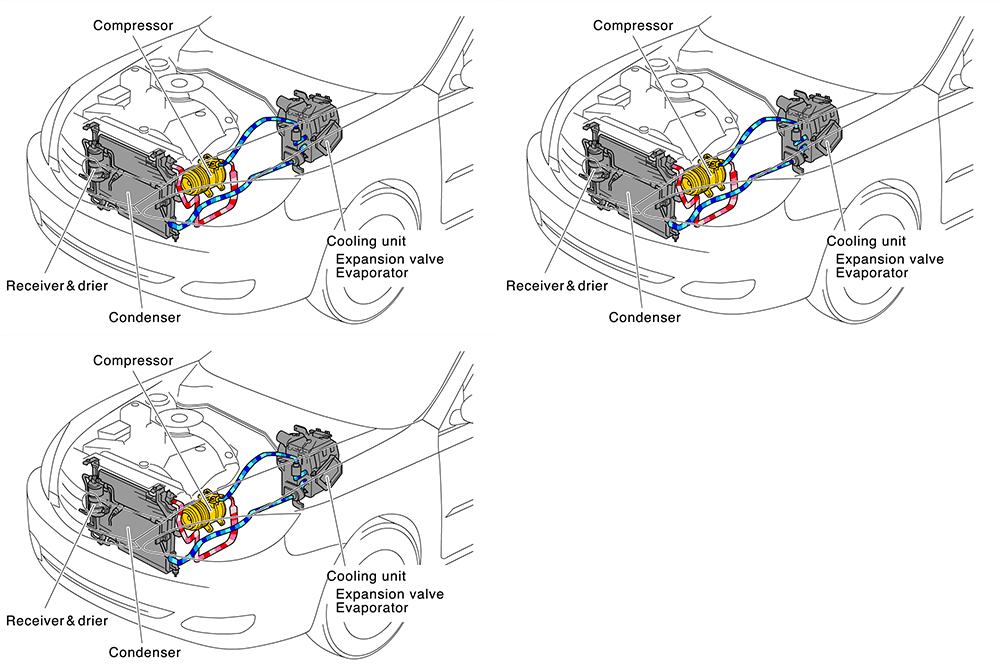
Imagine a closed loop filled with a special substance called refrigerant. This magic potion changes states (liquid to gas and vice versa) to absorb and release heat, creating the cooling effect. Here's the breakdown of the key players:
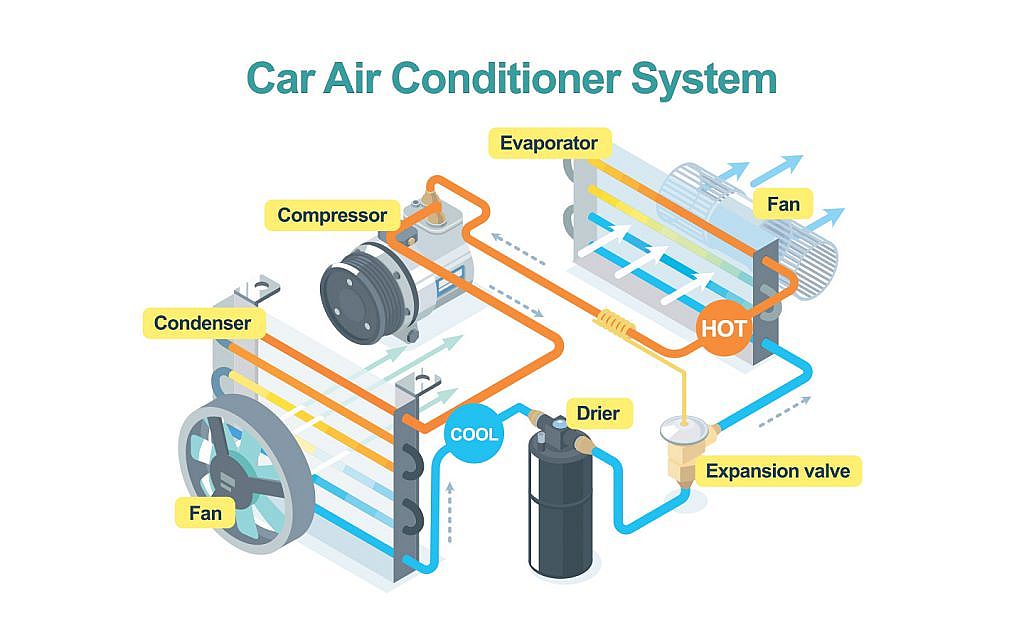
Compressor: The heart of the system, this pump pressurizes the refrigerant, turning it from a cool gas into a hot, high-pressure liquid. (Think of it like squeezing a sponge – the water gets hotter the harder you squeeze). This component is typically located near the engine and requires a significant amount of power to operate. Condenser: This radiator-like unit sits at the front of the car, usually near the grill. As the hot, high-pressure liquid refrigerant flows through the condenser, surrounding air carries away the heat, causing the refrigerant to condense back into a cooler liquid. Expansion Valve: Acting like a pressure relief valve, this component regulates the flow and pressure of the refrigerant. As the liquid refrigerant passes through the expansion valve, it experiences a sudden drop in pressure, causing it to rapidly expand and turn into a cold, low-pressure mist. Evaporator: This heat exchanger, typically located behind the dashboard, is where the magic happens. The cold, low-pressure refrigerant mist absorbs heat from the warm air inside the car, causing the air to cool down. This cool air is then blown into the cabin by the blower motor.
Location: How Each Component Impacts Performance
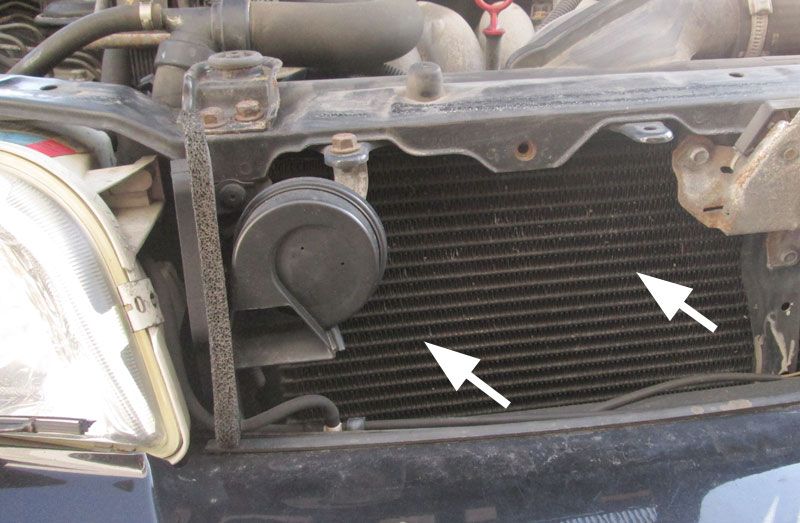 Placement is Crucial: The positioning of these components plays a vital role in system efficiency. The condenser needs good airflow (that's why it's near the grill) to effectively release heat, while the evaporator needs to be strategically placed to ensure proper air circulation throughout the cabin.
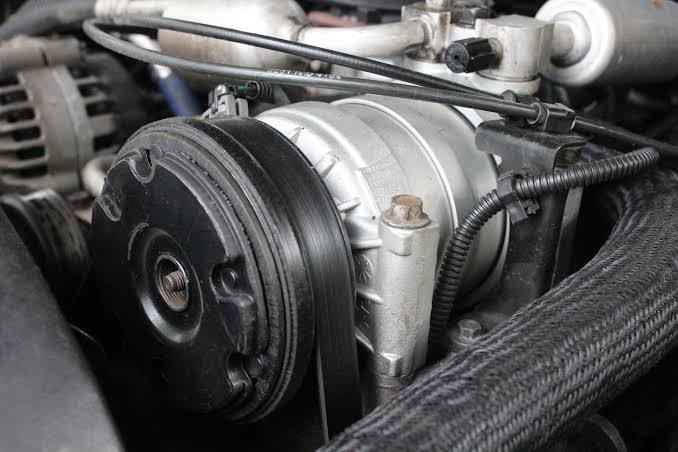 Power Hungry Compressor: The compressor is the system's biggest energy guzzler. Its location near the engine allows it to tap into engine power via a drive belt connected to the engine's crankshaft. This placement provides the direct mechanical power needed for compressing the refrigerant, but it also means that compressor operation can put a slight strain on the engine, reducing its overall power output.
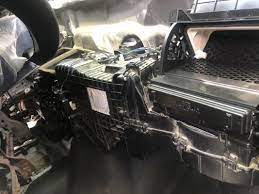 Evaporator: The evaporator in a car's HVAC system is typically located behind the dashboard, often deeply buried within or under the instrument panel. This placement allows the cool air it produces to be easily circulated throughout the cabin by the blower motor.
How auto-climate control works
Now that we've explored the core components and operation of a car's basic HVAC system, let's talk about Automatic Climate Control (ACC).
Unlike manually adjusting knobs, Automatic Climate Control (ACC) offers a set-and-forget approach to in-car comfort. It relies on a network of sensors that monitor cabin and exterior temperature, sunlight intensity, and even humidity. This data feeds into an Electronic Control Unit (ECU), the brain of the operation. The ECU then precisely controls components like the compressor, blower motor, and a special blend door. By adjusting their speed and operation, the ACC creates the perfect mix of hot (from the engine) and cool (from the evaporator) air to achieve and maintain your desired temperature. This not only ensures consistent comfort but also optimizes efficiency and prevents window fogging
Fuel Efficieny myths regarding AC
While it might seem intuitive that running your car's AC on a lower fan speed or setting a slightly higher desired temperature would significantly improve fuel economy, the reality is a bit frustrating.
The biggest factor impacting fuel economy when using the AC is the compressor. This component requires a significant amount of power from the engine to compress the refrigerant and create the cooling effect. So, whenever the AC is on, regardless of fan speed or temperature setting, the compressor is doing its job and consuming energy.
While a lower fan speed might seem like it uses less energy, the impact on fuel economy is minimal. The fan motor itself doesn't draw a significant amount of power compared to the compressor. In some cases, running the fan on a lower setting might actually force the compressor to cycle on and off more frequently to maintain the desired temperature, potentially negating any slight efficiency gain.